Friday, July 14, 2017

Week 13: Transitions in Marriage: In-Law Relations

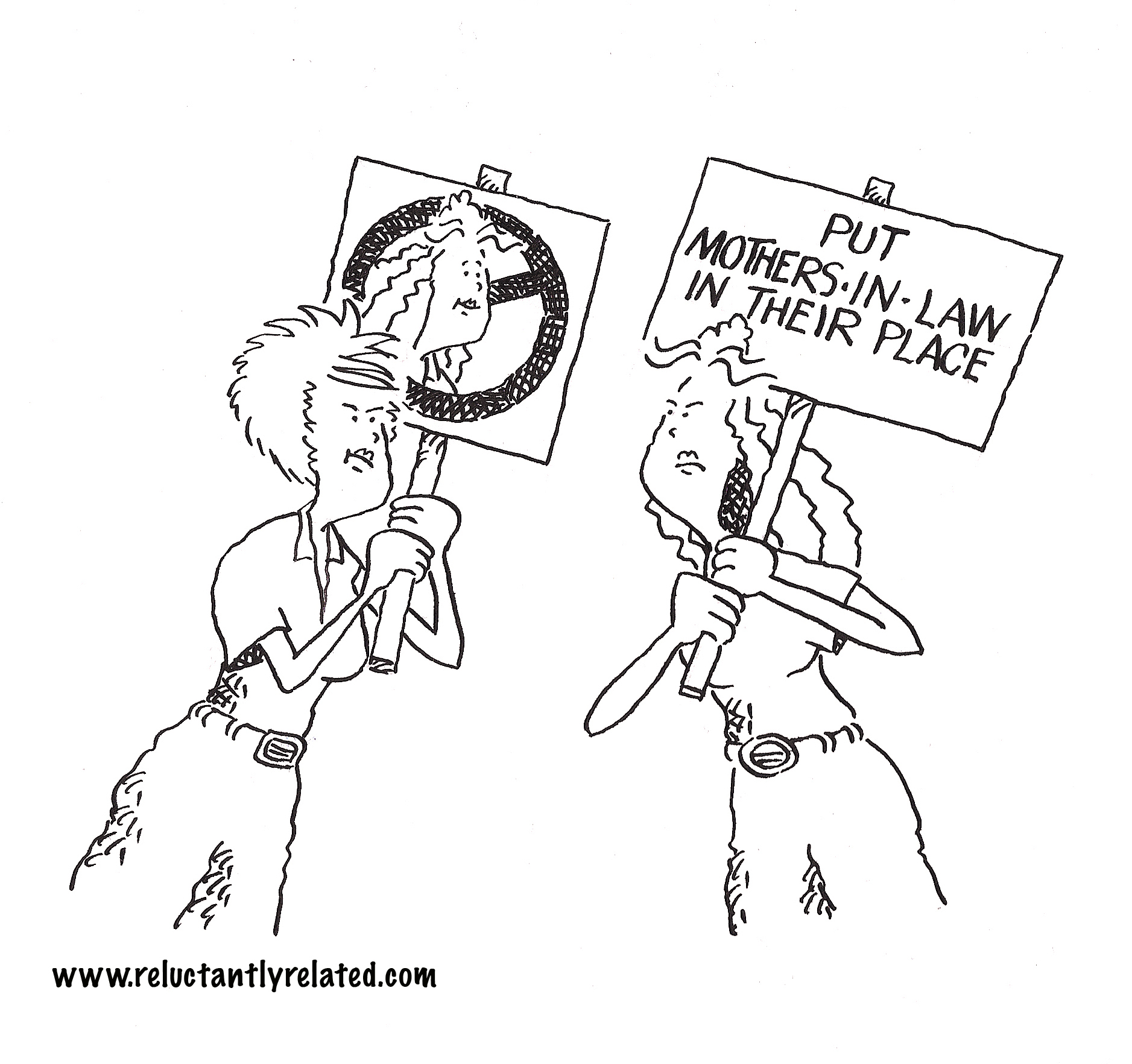
What do you think of when I say "Mother-in-law"?

Did you think of a meddler?
http://i.huffpost.com/gen/2075478/images/o-MOTHERINLAW-facebook.jpg


A busybody?
http://i.huffpost.com/gen/1604813/images/o-MOTHER-IN-LAW-facebook.jpg


An antagonist?
http://images.huffingtonpost.com/2014-09-16-Protestsigns.jpg 


Or an insufferable know-it-all?
http://www.scarymommy.com/wp-content/uploads/2014/07/mother-in-law.jpg


When I “googled” mother-in-law, these are some of the top images that appeared. Not very flattering, right?

Personally, I find it quite sad that our pop culture has developed such a negative connotation of mothers-in-law, and to a lesser degree, in-laws in general. While this may be partly in jest, I believe that there is still some underlying truth to this notion that many believe.

In his book “Till Debt Do Us Part” Bernard Poduska states that “we do not enter marriage empty handed; we carry a lot of ‘baggage’ with us.” (Poduska, 2000). An important fact to consider as couples enter marriage is that each is accepting the other as a package deal - the good, the bad, and the ugly; and this includes their family of origin, or in other words, in-laws.

There are many things a couple and their parents can do to avoid or overcome the difficulties associated with in-law relations and embrace this opportunity to create meaningful relationships with each other.

1.  Understand “Family Rules” (Poduska, 2000, p. 26) – Because of the upbringing in their particular families, each spouse brings with them into the marriage separate sets of “family rules”. According to Poduska, these rules act as a sort of family heritage that guides and direct with social roles, relationships, and behavior. Understanding a spouse’s heritage, or family rules, will not only help to understand them better but will allow a greater appreciation of the family from which they came and strengthen ties with in-laws.  

2. Create a Marital Identity (Harper & Olsen, 2005, p. 328) – Husbands and wives are commanded by God to leave their fathers and their mothers and cleave unto their spouses. (See Genesis 2:24). By so doing, they are able to create their own marital identity. It can be helpful to think of this as building an invisible fence around their marriage relationship. What goes on inside that fence is between the married partners, and they dictate what is shared with those outside the fence. Parents of married children can help them build and maintain their fence by avoiding intrusion and giving them the time, space, and freedom to create their marital identity.

3. Accept Differences (Harper & Olsen, 2005, p. 330) – Marrying into a family that is different from yours is inevitable, but it doesn’t have to cause difficulties. Using humor, using patience, overlooking small irritations, and looking for the positives can do much to avoid problems that arise from differences among family members and in-laws. A healthy approach to accepting additional family members through marriage is to realize that they will “bring new perspectives into the family, and the family can learn from these differences and be complemented by them.”

In my own experience, I’ve been lucky enough to marry into a wonderful family and have not experienced any difficulties in building close and trusting relationships with all of my husband’s family members. From the very beginning of our marriage, my husband’s parents have helped us establish our own marital identity by not demanding frequent contact (phone calls, texts, or attendance at every family function) and offering advice only when it is sought after. They have always shown support for decisions we make as we set up our own family rules, practices, and traditions. I have also never heard them speak ill of any of the other in-laws (and there are quite a few of us, 7 to be exact!) I know firsthand how enriching such relationships are in my life. Perhaps this is why I am so troubled by the popular stigma that identifies in-laws (especially mothers-in-law) in a negative light. None of my children are yet married, but I hope that when the day comes that I take on the role of mother-in-law I will be able to follow the counsel given above and my own mother-in-law’s example of how to build enriching relationships. I am looking forward to welcoming and accepting my children’s spouses into our family. 


I love my family of in-laws....
....even with all of our craziness!!

References:
Harper, J. M. & Olsen, S. F. (2005). "Creating Healthy Ties With In-Laws and Extended Families." In C. H. Hart, L.D. Newell, E. Walton, & D.C. Dollahite (Eds.), Helping and healing our families: Principles and practices inspired by "The Family: A Proclamation to the World" (pp. 327-334). Salt Lake City, UT: Deseret Book Company.


Poduska, B. (2000). Till Debt do us Part, Salt Lake City, Utah: Shadow Mountain.

Saturday, July 8, 2017

Week 12 - Transitions in Marriage: Power Relations and Children

When a man and a woman marry they are creating a new family and a new household. Each makes a transition from being a single person to jointly sharing a life with someone else. In making this transition, the question often arises:

Who’s The Boss?

Now, I’m not talking about the popular 80’s TV sitcom, but rather the more serious issue of who holds the power or control in the relationship. Often this is a source of serious marital problems. The wife may feel that her opinion is not valued or desired or that her husband does not consult her regarding important family decisions. The husband may feel that he has no say over disciplining the children or managing the household. According to Dr. John Gottman, “When there’s an imbalance of power, there’s almost inevitably a great deal of marital distress.” (Gottman, p. 115). Likewise, Richard B. Miller states “Many marital problems have as their root cause an unequal relationship or struggles over who has control in the relationship.” (Miller, 2008).

Perhaps the first step to eliminating power struggles in marriage is to recognize that in a healthy marriage relationship there is no “boss”. In The Family: A Proclamation to the World we are taught “By divine design, fathers are to preside over their families in love and righteousness and are responsible to provide the necessities of life and protection for their families. Mothers are primarily responsible for the nurture of their children. In these sacred responsibilities, fathers and mothers are obligated to help one another as equal partners.” (Hinckley, 1995). Husband and wife share power as equal partners, even though their responsibilities may be different. Instead of asking “Who’s the Boss?” each spouse should instead be asking:

“What is my role as an equal partner in this relationship?”

Answering this question is going to be different for every couple and will change throughout the course of the marriage relationship. For my husband and me, our relationship roles have constantly changed as we have experienced the births of our children, job changes, relocating our family, parenting teenagers, having children leave home for college and missions, fulfilling various church responsibilities, and a myriad of other influences that take up our time and energy. Throughout our marriage there have been times when we were each so focused on our individual roles that we neglected to work together as equal partners. I did my thing, he did his, and before we knew it we felt distant from one another. What we have found to be most beneficial in coming together again as husband and wife is to counsel often with each other. We talk about specific things going on in our lives – our stresses, our fears, our joys and our triumphs. In addition, we try to lift each other’s burdens by finding ways to help and support the other.
Although husbands and wives, fathers and mothers, have different roles, what is required for a happy, equalized marriage is unity. In his talk, That We May Be One, Elder Henry B. Eyring taught how it is possible for the gospel of Jesus Christ to unite our hearts. “The gift of unity will come through obedience to the laws and ordinances of the gospel of Jesus Christ. When we keep our covenants to take His name upon us, to remember Him always, and to keep all His commandments, we will receive the companionship of His Spirit. That will soften our hearts and unite us.” (Eyring, 1998). I believe that achieving such unity in marriage is a lifelong process that requires diligence, patience, and forgiveness. From my experience I have found that when I forget about determining “who’s the boss”, and instead focus on what I can do to be an equal partner in my marriage, there is a greater feeling of mutual compassion, caring, and support. Together as husband and wife, with the companionship of the Holy Spirit, we are able to achieve much more than we ever could on our own!
Resources:
Eyring, H. B., “That We May Be One, Ensign, May 1998, p. 66.
Gottman, J. M., & Silver, N. (2015). The seven principles for making marriage work: a practical guide from the country's foremost relationship expert. New York: Harmony Books.
Miller, R. B., (2008). “Who Is the Boss? Power Relationships in Families”, Brigham Young University. 

Saturday, July 1, 2017

Week 11 - Transitions in Marriage: Fidelity and Pysical Intimacy

Physical intimacy in marriage is a topic that is often misunderstood. On the one hand we live in a society that glorifies sexuality as a means of personal gratification. Movies, TV shows, music, magazines, social media, and even ads are constantly bombarding us with sexual images and innuendos promoting the idea that being and looking sexy will bring you happiness, popularity, and wealth. On the other hand there are those who view sex as a necessary evil only to be endured for the sake of reproduction. In each case, these limited ideas of sexuality can cause great difficulties for married couples. So just what is the proper view of physical intimacy and sexuality?
In the Church of Jesus Christ of Latter-day Saints we are taught that “the sacred powers of procreation are to be employed only between man and woman, lawfully wedded as husband and wife.” (The Family: A Proclamation to the World, 1995). In a talk given in October 1994, Elder Richard G. Scott taught:

https://mybestlds.files.wordpress.com/2016/01/marriage-and-intimacy.jpg

It often happens that after marriage, one of the areas in which couples struggle the most is with sexual intimacy. Brent A. Barlow said, “We are well aware of the joy and unity that can come to a married couple when this particular dimension of the marital relationship is nurtured. Yet, in spite of the potentially joyful aspects of sexuality in marriage, for many it is a source of frustration and even contention. Indeed, the inability of married couples to intimately relate to each other is one of the major causes of divorce.” (Barlow, 1986).

Perhaps the most important thing a couple can do to foster a healthy intimate relationship is learn to communicate about it with each other. According to Barlow, couples often think that marital intimacy is something that should just naturally work out, and that if they have to talk about it then it means something is going wrong. (Barlow, 1986). Yet open communication is key to improving this area of the marriage relationship. Husband and wife should seek to understand each other’s needs, hopes and aspirations. There is no shame in talking about intimacy as a husband and wife, but it can certainly make one feel vulnerable to open up so much. It may take patience, tenderness, and gentleness to eventually reach a point where both spouses feel comfortable talking about this aspect of their relationship.

https://mybestlds.files.wordpress.com/2016/01/tenderness-and-respect.jpg 
In order for couples to fully enjoy physical intimacy in their marriage relationship as it was intended by God, they must first seek for a proper understanding of its place in marriage. They should then work together to understand one another and nurture this aspect of their relationship with tenderness, patience, and open communication. In addition, there are countless resources available for couples to help them understand and improve upon this sacred part of their marriage: The Act of Marriage: The Beauty of Sexual Love by Tim and Beverly LaHaye, Between Husband and Wife: Gospel Perspectives on Marital Intimacy by Stephen Lamb and Douglas Brinley, and They Were Not Ashamed: Strengthening Marriage Through Sexual Fulfillment by Laura M. Brotherson, just to name a few.

Although physical intimacy in marriage can be a difficult area for many couples, I know that it is part of God’s plan for happy marriages. There is a closeness and depth of connection that is possible as husband and wife work together to understand and fulfill each other’s needs and expectations. God does not intend for sexual intimacy to only be used for procreation, but also as a means for couples to achieve a oneness in their marriage that is beautiful and amazing. 
Resources:
- Barlow, B. A.,  "They Twain Shall Be One: Thoughts on intimacy in marriage,", Ensign, Sept 1986, p. 49.

- Scott, R. G., "Making the Right Choices", Ensign, Nov. 1994, p. 38.