Did you think of a meddler?
 |
| http://i.huffpost.com/gen/2075478/images/o-MOTHERINLAW-facebook.jpg |
A busybody?
 |
| http://i.huffpost.com/gen/1604813/images/o-MOTHER-IN-LAW-facebook.jpg |
An antagonist?
 |
| http://images.huffingtonpost.com/2014-09-16-Protestsigns.jpg |
Or an insufferable know-it-all?
 |
| http://www.scarymommy.com/wp-content/uploads/2014/07/mother-in-law.jpg |
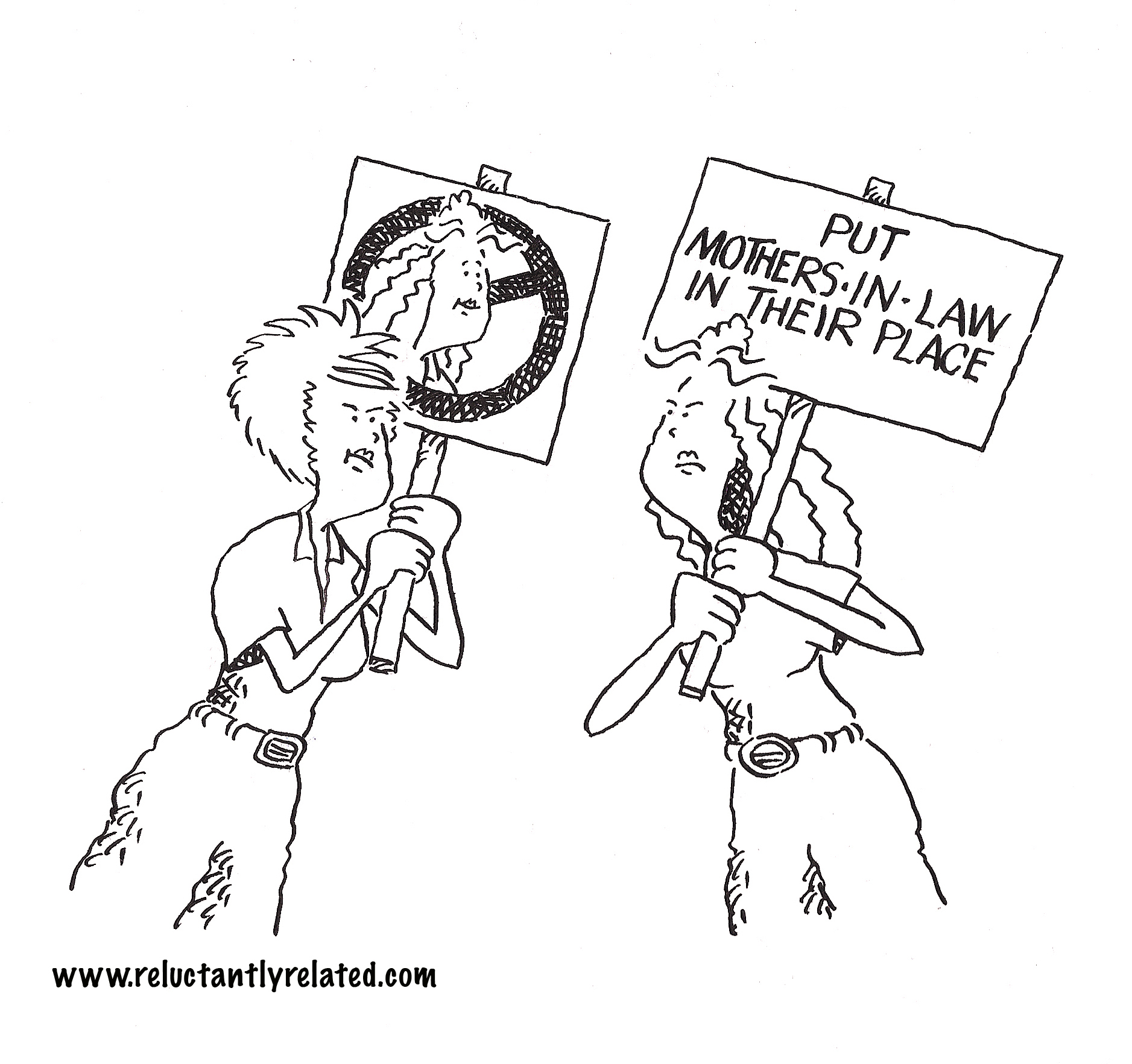
When I “googled” mother-in-law, these are some of the top images that appeared. Not very flattering, right?
Personally, I find it quite sad that our pop culture has developed such a negative connotation of mothers-in-law, and to a lesser degree, in-laws in general. While this may be partly in jest, I believe that there is still some underlying truth to this notion that many believe.
In his book “Till Debt Do Us Part” Bernard Poduska states that “we do not enter marriage empty handed; we carry a lot of ‘baggage’ with us.” (Poduska, 2000). An important fact to consider as couples enter marriage is that each is accepting the other as a package deal - the good, the bad, and the ugly; and this includes their family of origin, or in other words, in-laws.
There are many things a couple and their parents can do to avoid or overcome the difficulties associated with in-law relations and embrace this opportunity to create meaningful relationships with each other.
1. Understand “Family Rules” (Poduska, 2000, p. 26) – Because of the upbringing in their particular families, each spouse brings with them into the marriage separate sets of “family rules”. According to Poduska, these rules act as a sort of family heritage that guides and direct with social roles, relationships, and behavior. Understanding a spouse’s heritage, or family rules, will not only help to understand them better but will allow a greater appreciation of the family from which they came and strengthen ties with in-laws.
2. Create a Marital Identity (Harper & Olsen, 2005, p. 328) – Husbands and wives are commanded by God to leave their fathers and their mothers and cleave unto their spouses. (See Genesis 2:24). By so doing, they are able to create their own marital identity. It can be helpful to think of this as building an invisible fence around their marriage relationship. What goes on inside that fence is between the married partners, and they dictate what is shared with those outside the fence. Parents of married children can help them build and maintain their fence by avoiding intrusion and giving them the time, space, and freedom to create their marital identity.
3. Accept Differences (Harper & Olsen, 2005, p. 330) – Marrying into a family that is different from yours is inevitable, but it doesn’t have to cause difficulties. Using humor, using patience, overlooking small irritations, and looking for the positives can do much to avoid problems that arise from differences among family members and in-laws. A healthy approach to accepting additional family members through marriage is to realize that they will “bring new perspectives into the family, and the family can learn from these differences and be complemented by them.”
 |
| I love my family of in-laws.... |
 |
| ....even with all of our craziness!! |
References:
Harper, J. M. & Olsen, S. F. (2005). "Creating Healthy Ties With In-Laws and Extended Families." In C. H. Hart, L.D. Newell, E. Walton, & D.C. Dollahite (Eds.), Helping and healing our families: Principles and practices inspired by "The Family: A Proclamation to the World" (pp. 327-334). Salt Lake City, UT: Deseret Book Company.
Poduska, B. (2000). Till Debt do us Part, Salt Lake City, Utah: Shadow Mountain.




No comments:
Post a Comment